
Reliability Culture: Invest in Your People
A Business's Greatest Asset Is Its Culture And Its People
In my August 2025 blog, I wrote about the four areas needed to build a solid maintenance and reliability program: #1 Do the basic foundational maintenance and reliability requirements well. #2 Operate in a data driven and proactive decision making manner. #3 Embrace innovation and technology. #4 Invest in your employees. Your people are your greatest asset and this quarter we are going to look more deeply into how to support your people in the rapidly changing reliability culture. From the August blog:
It is said that a business’s greatest asset is its culture and its people. I agree and lean toward the people being most important. If the value of our human assets is that high, then there should be a willingness to invest in our teams.
- Begin in the hiring process and all the tools exercised to get the correct resources hired - job descriptions, benefits packages, fair compensation, etc., are all key.
- Give new hires the resources necessary; positioning them and helping them to achieve success.
- Put forth effort to train the employees and continue to enhance their skill sets as equipment, technology, and innovation advances.
- Help employees to advance in their career path.
- Create and maintain an environment where the employees want to work and bring value - company culture is essential.
As we explore the topic of people, it is important to establish that organizational and reliability culture are two separate but intertwined topics. The same is true of people and culture. My goal is to show you tools that can support you as you go on this vital journey.
Culture is an abstract thing, and it is extremely difficult to measure. You do not see it, you feel it. Ramesh Gulati defines culture as “a common set of values, beliefs, attitudes, perceptions, and accepted beliefs shared by individuals within an organization.” Two resources are helpful in developing a greater understanding of the dynamics at play. The first is from Erik Hupje and the team at the Reliability Academy. They have created a great report and framework titled Four Elements of Reliability Culture. The second, People and Culture at Work (PCW) Passport, is from Terrence O’Hanlon and the team at Reliabilityweb.com. It is a 200 page examination of the subject matter. Both tools do an excellent job of explaining how to establish a culture that is supportive of your people while attaining your business and reliability goals.
The Four Elements of Reliability Culture is a great starting point because it defines the building blocks that shape organizational mindset and day-to-day behavior. Adapted from classic corporate culture models these elements represent how culture is defined, demonstrated, and reinforced on the plant floor. The Four Elements Framework (Figure 2) explains how this is accomplished through Values; Work Processes and Practices; Role Models and Rewards; and Behaviors.
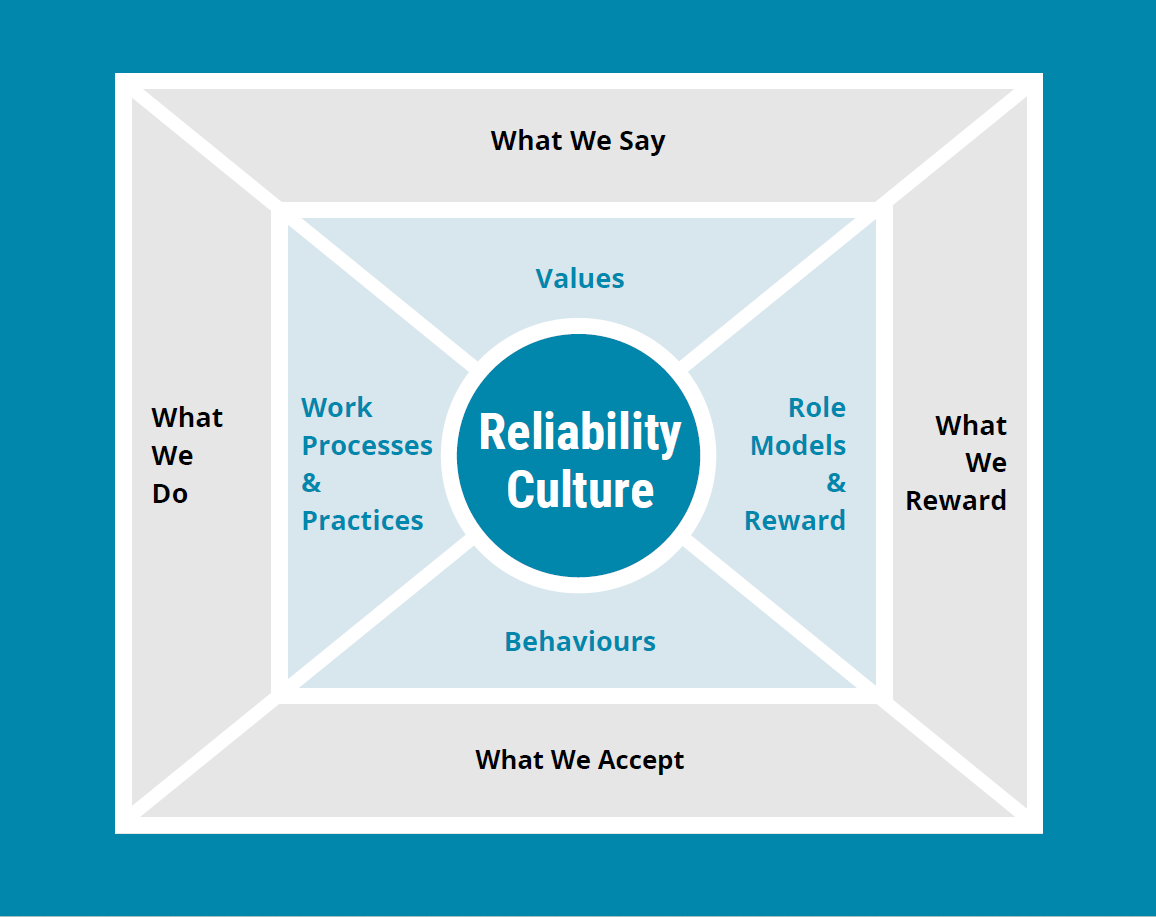
Figure 1 - Four Elements Framework
- Element#1 Values: Values are the core beliefs and principles that guide an organization’s decisions, actions, and behaviors. They form the foundation of your culture and provide a framework for how employees should act and treat one another. These are typically reflected by what we say, like “reliability is important” or “safety is a priority.”
- Element #2 Work Processes & Practices: In real life, what we say is often contrasted by what we do and that is reflected by our work processes and practices. Work processes formalize how work is done and, as such, strongly influence reliability culture. Poorly defined, loose, or inconsistent work processes will drive you to a much more reactive reliability culture.
- Element #3 Role Models and Rewards: What you say is important. What you do is even more important. However, what you reward is key to your success. Sure, people respond to role models but I strongly believe people respond more powerfully to how they are rewarded and recognized. Also, keep in mind that when it comes to role models, your managers and leaders should personally exhibit the right behaviors and work practices.
- Element #4 Behaviors: What we accept in business, in essence, reflects the behaviors we accept from our people. This is a slightly simplistic but practical way to frame the concept of the 'Cultural Network' as defined by Deal and Kennedy which include informal communication channels and relationships like gossip, storytelling, mentoring, and other informal interactions.
As always Erik presents a straightforward approach that is useful and implementable. The Four Elements Framework will build the necessary foundation; drive day to day results; and position a company for sustained success.
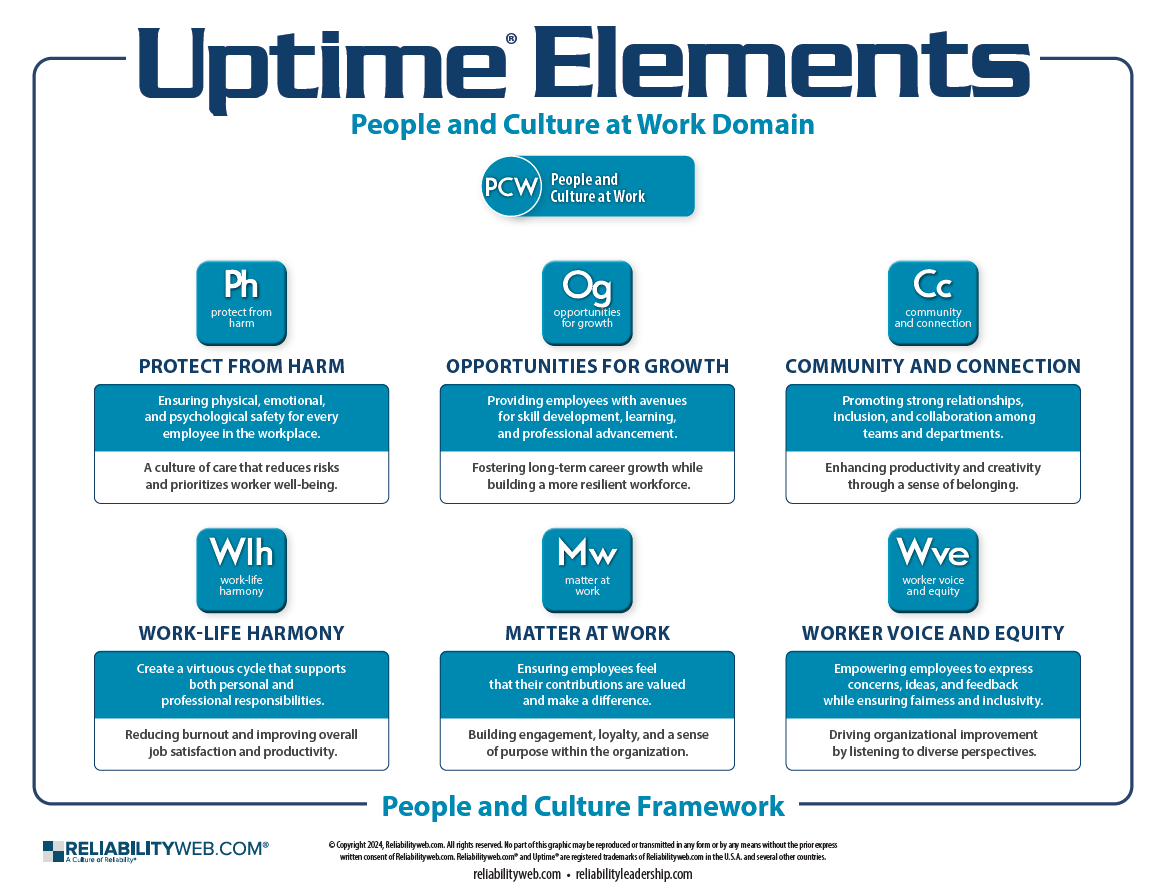
Figure 2 - PCW Framework
The PCW Passport is a knowledge domain within the Uptime Elements framework. This domain contains six elements: Protect From Harm; Opportunities For Growth; Community and Connection; Work-Life Harmony; Matter at Work; and Worker Voice and Equity (Figure 2).
The Passport details the human, cultural, and organizational side of maintenance and reliability within the broader Uptime Element Framework. It also addresses why most transformations fail: cultural resistance, lack of engagement, and poor leadership alignment. The PCW Domain integrates technical, maintenance/reliability, and organizational/workforce development through four items:
- Executive & Leadership Sponsorship: Establishing clear executive support to fund and aligning reliability initiatives with strategic business goals.
- Human Capital Management (HCM) & Competency: Moving from ad-hoc training to structured, competency-based learning and skills development paths across cross-functional teams.
- Cross-Functional Synergy: Breaking down functional silos between maintenance, operations, purchasing, engineering, and management to make reliability a shared responsibility.
- Empowered Workplace Culture: Building a high-trust, value-driven environment guided by core values—integrity, authenticity, and accountability.
To be successful in something that is difficult to measure is extremely challenging. The best hope is to establish contingency plans as you walk the trial and error path of building strong culture and people within your organization. Realize that there is not a one-size-fits-all approach that will solve your problems or eliminate your challenges. Most likely you will have to combine items from various resources and frameworks to accomplish your goals. This blog showed only two resources, there are several other companies and products that provide support. Lastly, this will be an ongoing endeavor, not a line in the sand moment. Culture and people will change over time. Feel free to reach out if you have questions or need a sounding board - rpc@russpconsulting.com or 813-313-6867.
Common Sense Reliability