
Reliability and the Age of Artificial Intelligence
Reliability and Artificial Intelligence (AI), a match made in heaven?
We are in an age of ever changing and rapidly evolving technological advancement. Over the last few years, technology has advanced from Digital Transformation to Internet of Things (IoT) and now to Artificial Intelligence (AI). As the usage of AI increases, it will come as no surprise that information technology change and advancement are only going to move more rapidly. This blog will help to define terms and information around reliability and AI. We will evaluate the need for combining reliability practices with AI and define practical applications of each. As we wrap up, we will explore the future applications and implications of AI.
Most believe that AI is a recent technology; however, AI has been around since the 1950’s. Figure #1 shows the evolution of AI during the previous eight decades.
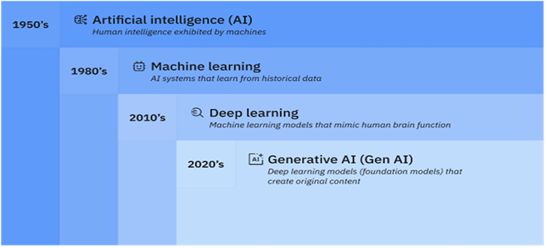
Figure #1 – AI to Generative AI (Stryker & Kavlakoglu, 2024)
To begin, let us level set on terms and definitions, specifically those associated with AI. I believe this audience has a knowledgeable understanding of terms associated with reliability. [If a review is needed on reliability terms, a great resource is Ramesh Gulati’s Certified Reliability Leader Pocket Dictionary.] AI terms to be defined:
- Artificial Intelligence (AI) – The study of how to build, create, and use:
- Systems that think like humans.
- Systems that think rationally.
- Systems that act like humans.
- Systems that act rationally.
- Simplified AI is technology that enables computers and machines to simulate human learning, comprehension, problem solving, decision making, and autonomy.
- Machine Learning (ML) - The use of data to improve performance of associated, targeted and AI systems over time. It is a system that learns from historical data.
- Deep Learning (DL) – ML with deep neural networks. These are ML models that mimic human brain function.
- Neural Networks – Artificial networks that are modeled after the human brain’s structure and function. These networks consist of interconnected layers of nodes that work together to process and analyze complex data.
- Generative Artificial Intelligence (Gen AI) – AI used to generate content – i.e., text, image, videos, etc. These are DL models that create original content.
- Natural Language Processing (NLP) – Language modeling that correlates probability distribution or a collection of rules to capture properties of human language models. The most common of these is the Large Language Model (LLM), which is the foundation of products like Chat GPT. LLM’s are a type of DL architecture used for language processing (USF, 2025).
These concepts can be a bit overwhelming. The key takeaways are that applications and devices equipped with AI can:
- see and identify objects
- understand and respond to human language
- learn from the latest information and experience
- make detailed recommendations to users and experts
- act independently, replacing the need for human intelligence or intervention (a classic example being a self-driving car)
However, AI is not perfect and has weaknesses.
- It makes mistakes (called hallucinations).
- There are bias/stereotypes built into AI responses.
- There are ethical issues surrounding AI use.
- AI’s responses are only as good as the information it has evaluated, or the prompt used to create the output.
The AI weaknesses are the catalyst for using reliability practices and AI together (Stryker & Kavlakoglu, 2024).
Reliability is the foundation for the assets that are driving operations and maintenance practices. Reliability is defined as, “the probability that an asset, item or system will perform its required functions satisfactorily under specific conditions within a certain time period. (Gulati, 2015, pg. 85)” Expand this to include Reliability Centered Maintenance (RCM); which is a systematic, disciplined process for establishing the appropriate maintenance plan/requirements for an asset/system to minimize the probability of failure (Gulati, 2015, pg. 86). When businesses account for things like Failure Modes Effect Analysis (FEMA), Root Cause Analysis (RCA), process/procedure/checklists, planned/predictive maintenance, continuous improvement, CMMS, and planning/scheduling, they are developing the data from which AI will evaluate and deliver. The quality of all this information, and more, will determine how effective AI becomes. Just as maintenance, operations, reliability (MOR) can be continually improved, so can the accuracy of AI. Again, these are the foundational pieces of an AI and reliability partnership. Company maturity will have a significant impact on the success of both AI and reliability. Additionally, buy-in of leadership, skillsets of employees, investment in training, discipline in following process, and strategic planning are examples of items that will also impact success.
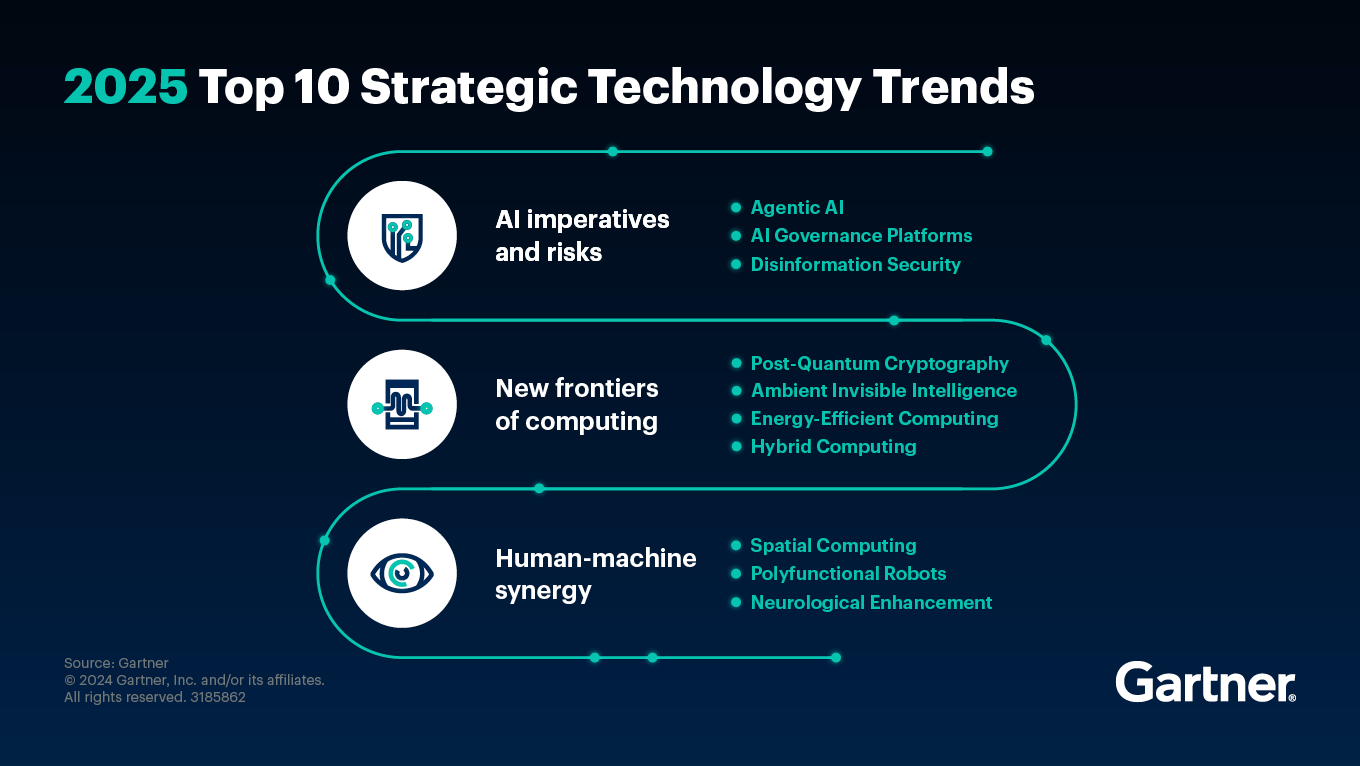
Figure #2 - 2025 Top 10 (Gartner)
Reliability is a defined and stable set of practices and expectations. Technologies including AI, ML, etc. are evolving quickly and reliability must also adapt. At this point, AI is the larger variable. AI hype must be balanced with AI caution. Sixty-five percent of respondents in a recent survey are anxious about how fast AI is moving (USF, 2025). This has led to a bigger problem known as AI FOMO (Fear of Missing Out). AI FOMO is the fear of missing the rapid changes and immense promise AI brings (USF, 2025). AI and ML will continue to advance and have a greater impact on industry in the future. The quicker companies adapt and start moving on the AI journey; the quicker they will see improvement. Companies who decide not to move forward will be at a competitive disadvantage. Those that choose to wait will be left behind. Figures # 2-4 show how Gartner saw innovation in 2025; sees innovation in 2026; and what CIOs will need to do to successfully move forward.
Good luck!
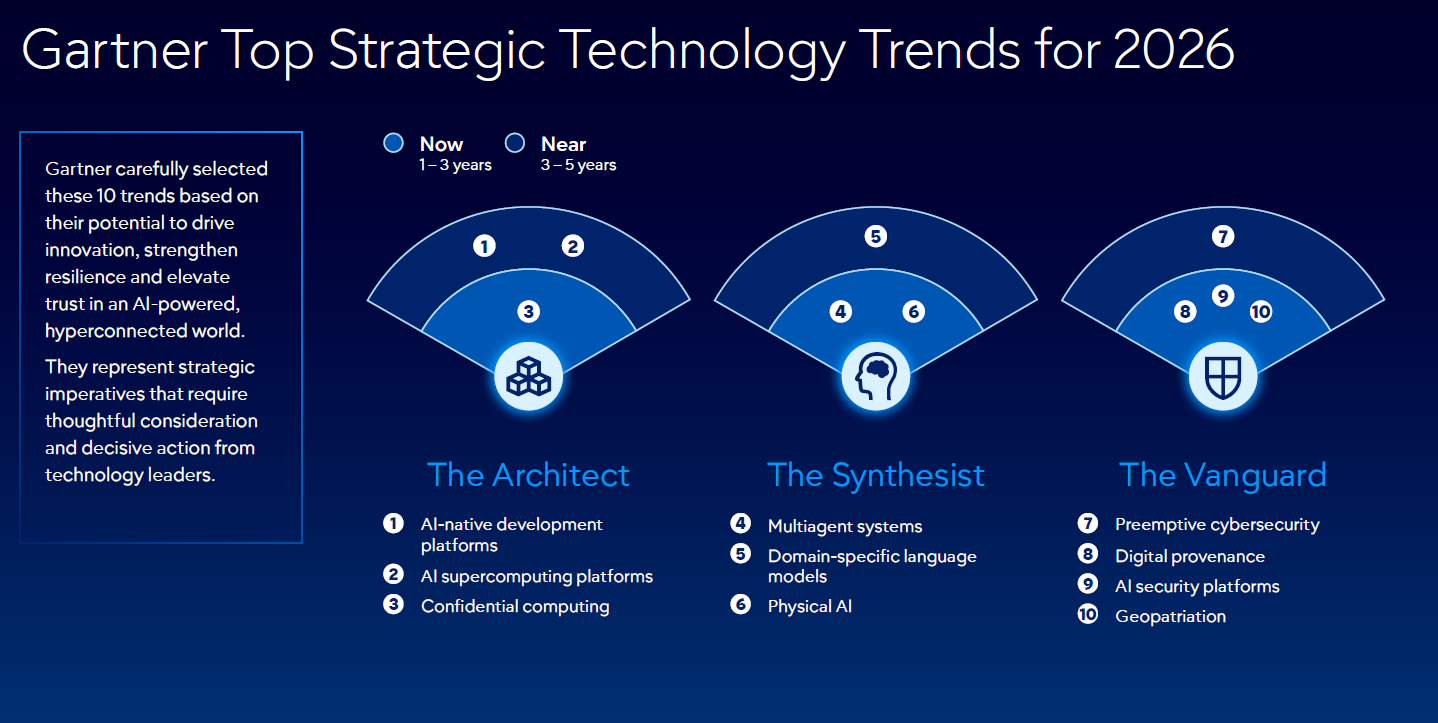
Figure #3 – 2026 Top 10 (Gartner)
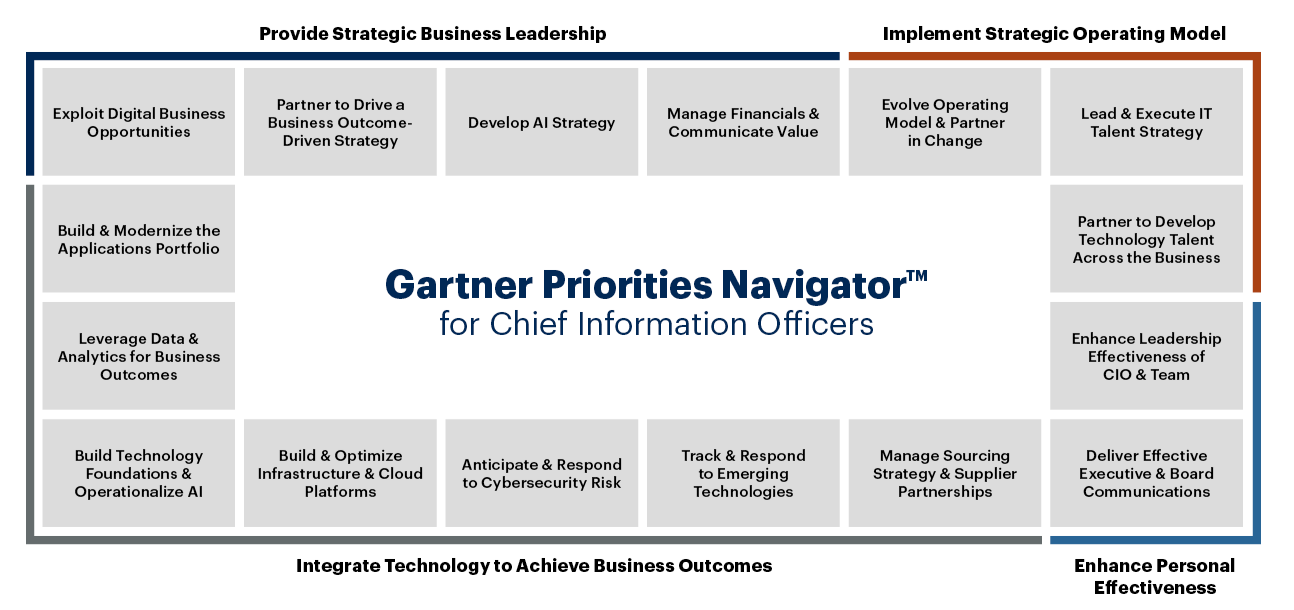
Figure #4 – CIO Priorities (Gartner)
References
- Various Instructors (2025), University of South Florida, Gen AI in Action: Impact and Possibilities Course. Taken November 2025 – December 2025
- Cole Stryker & Eda Kavlakoglu (2024), What is Artificial Intelligence?
- Ramesh Gulati (2015), Certified Reliability Leader Pocket Dictionary, pgs. 85-86
- Gartner Presentations (Various) – sited on graphics.
Common Sense Reliability