What Are Planning & Scheduling and Why Is Being Successful at Them Important?
2026 is upon us and it is an ideal time to look at one of my favorite topics – planning and scheduling (P&S). P&S are two of the most important foundational pieces in both my business and personal life. With the new year just beginning this is the ideal time to dive in.
What are P&S and why is being successful at them important? The idea behind P&S is that we do the right thing, at the right time, at the right cost, and with the minimum acceptable risk. Ramesh Gulati defines them as:
- Planning – The process of determining the resources and methods needed, including precautions, tools, skills, and time necessary to perform work efficiently and effectively.
- Scheduling – Deciding what gets done, by whom, and when based on priorities, resources, and availability.
- Planning is the what and how, while scheduling is the who and when.
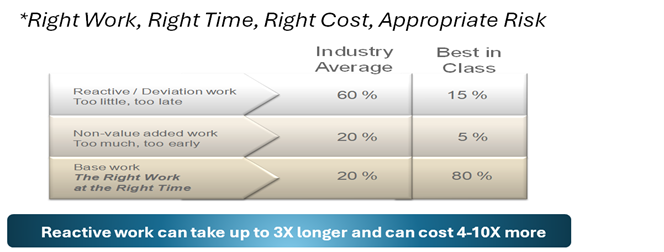
These definitions point to maintenance and reliability practices but can easily be modified for personal use. Think about the processes one employs if they are planning a vacation, juggling multiple children involved in various activities, balancing whose family they are visiting during holiday time, etc. Planning and scheduling play a big part in day-to-day, week-to-week, and month-to-month life. In life and in work, P&S allows a shift from being reactive to proactive. Figure #1 shows SMRP benchmarking, which captures the cost of being reactive. A reactive response takes up to three times longer and can cost 4-10 times more!
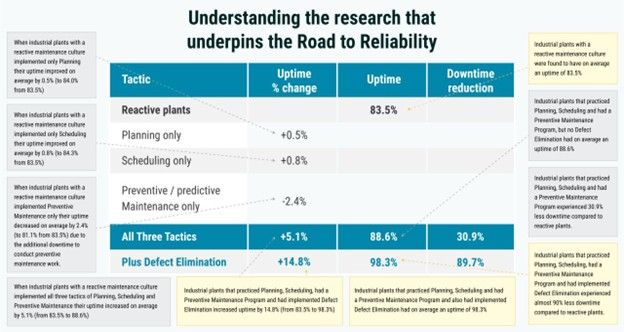
The best way to look at P&S is to see how one would incorporate it with other items to improve proactivity. The first thing to understand is that P&S are pieces, particularly important foundational pieces in a much larger overall puzzle. The next thing to realize is that P&S is both an art and a science. Want to increase uptime? P&S can play a significant role. By themselves P&S are going to improve desired results, but not as effectively as when combined with other benefit pieces. Figure #2 shows the impact of P&S on uptime; P&S with a preventative/predictive maintenance program (PM); P&S, PM program, and defect elimination (DE). With P&S, a 1.3% increase in uptime is produced. While a PM program adds 2.4%, combining P&S and PM will increase uptime by 5.1%. The biggest variable here is implementing DE analysis. Combining it with all the other pieces mentioned increases uptime by 14.8% to 98.3%.
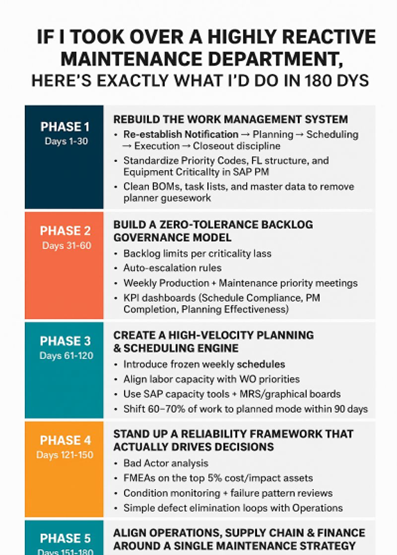
Figure #3 - Proactive Shift Phases (Allen Inapi graphic)
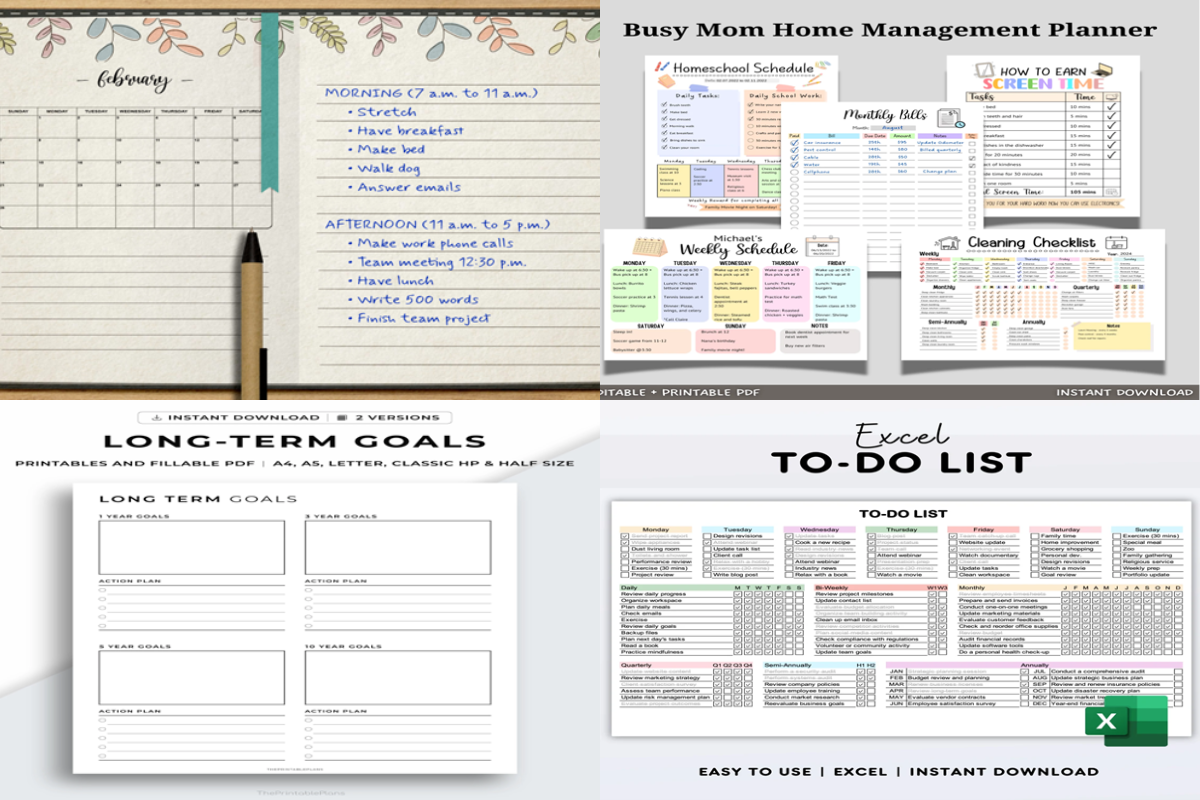
When we look at planning and scheduling in our personal lives it is similar to aspects we have examined in the business aspect, but there are obvious differences. Figure #4 shows examples of different tools available to support one’s P&S in their personal life. Similarities between personal and professional P&S include goalsetting, developing plans (daily, weekly, monthly, long-term, etc.), posting information, communicating expectations, learning from mistakes, and continuous improvement. The need to not waste time or money is paramount in many homes. Lastly, the key to success here is the effort and discipline to follow what you have planned. There will need to be more flexibility in personal P&S as there are more opportunities to deviate from the plan. Being successful at P&S is a skill that is honed and developed over time, but one that is a key contributor to personal and family achievement.
To an extent, success is measured by the goals one achieves. P&S are foundational tools that can be used both personally and professionally to more effectively reach one's goals. In this technological age, there is no shortage of P&S tools available. Many of RPC's company partners have developed cutting edge tools to help in this area. AI can be a significant asset in scheduling, analysis of information and data (including financial), and continuous improvement. As stated earlier, combining tools and processes will help create a powerful P&S approach. However, technology alone does not do the work, success still hinges on human implementation, use and discipline.
If you or your company need help in choosing the right tools to achieve your goals, Russ Parrish Consulting would be happy to help you sort through the myriad of choices to find the right fit for your needs.